01
Establish the threat environment
Documented, sourced, and specific to the organization, site, and surrounding environment.
 THE GRANT GOATPM3 University · Readiness Before Requests
Cameras. Access control. Doors. Lighting. Fencing. Security personnel. Emergency preparedness. The Nonprofit Security Grant Program helps eligible nonprofits fund critical security improvements. It is not a loan.
CHECK ELIGIBILITY & SERVICE FITThis short overview should explain what NSGP can fund, why eligibility alone is not enough, what the assessment will tell you, and why preparation before the state cycle opens matters.
You have walked your building and seen it. The door that does not lock right. The lot with no lighting. The entrance anyone can walk through during a service or a program. You may have already priced the fix.
A real camera system, controlled entry, and lighting is a capital project. It competes with programs, payroll, maintenance, and the roof.
Congregations, children, staff, volunteers, and neighbors walk into your building because they believe it is safe. That responsibility does not shrink to fit your budget.
A break-in. Vandalism. A threatening message. Suspicious activity. Or a nearby incident involving an organization enough like yours to make you think differently about security.
You searched the program, landed on a government page written for grant professionals, and still did not know whether your organization should pursue it.
Federal funding administered through your state can help at-risk nonprofits harden facilities, strengthen preparedness, and protect the people they serve.
Cameras, access control, doors, windows, barriers, fencing, and exterior lighting.
Alarms, public address systems, and emergency communications equipment.
Security planning, emergency procedures, and exercises designed to improve response.
Eligible security training for staff, volunteers, and leadership.
Certain eligible contracted security costs, where permitted in the cycle.
Improvements tied directly to documented vulnerabilities and risks.
Congress formally authorized NSGP in 2019 and strengthened it again in 2022. National appropriations move from year to year, but the program has become an established federal security-funding pathway for nonprofits.
First, check your organization and site against basic NSGP conditions. Then tell us whether you want to explore professional assistance or prefer free federal resources. You will receive a clear next step, without a second screening form. This is not an official FEMA or state eligibility determination or an assessment of competitiveness.
This checks preliminary fit only. FEMA and your state make official eligibility and award decisions.
The PM3 NSGP Assessment is an independent readiness and case-strength tool. It is not an official FEMA, DHS, or state administering agency product. Your responses are used to generate your preliminary assessment results and support requested follow-up.
Do not submit passwords, alarm codes, camera credentials, access-control credentials, classified information, or law-enforcement-sensitive material. Formal eligibility and program requirements are governed by the current federal and state guidance for the applicable cycle.
Thousands of nonprofits may be able to pursue the program. Far fewer build a case that survives review. In Florida's FY2025 cycle, more than 500 nonprofit applications were submitted and 79 were funded.
One state, one cycle, from organizations with real security needs.
Many deserving applicants still could not be funded.
Qualifying gets you into the pool. It does not get you out of it.
Five reasons applications fail have little to do with how polished the narrative sounds. Each can weaken the case before the writing even begins.
Saying your organization feels at risk is not the same as documenting a threat environment reviewers can understand and support.
The assessment should reveal the site's actual security gaps. If it is rushed, the project often starts to look disconnected from the need.
Requested items should trace back to identified vulnerabilities and the threat environment. A mismatch can weaken an otherwise promising application.
Procurement, reporting, financial management, project oversight, and reimbursement capacity matter after an award and influence readiness before one.
State deadlines move quickly. Threat documentation, site assessment, project development, estimates, and internal approvals all take time.
Strong cases are built in sequence so the narrative documents a case that already exists instead of inventing one at the deadline.
Documented, sourced, and specific to the organization, site, and surrounding environment.
Identify where the facility's meaningful security gaps are.
Every requested improvement should connect to a vulnerability and security rationale.
Show that the organization can manage procurement, cash flow, documentation, and reporting.
At that point, the narrative is documenting the case rather than trying to manufacture one.
Complete one eight-question check. Potential consulting clients then provide a short organizational profile before choosing an appointment; visitors seeking only free information can continue to FEMA resources.
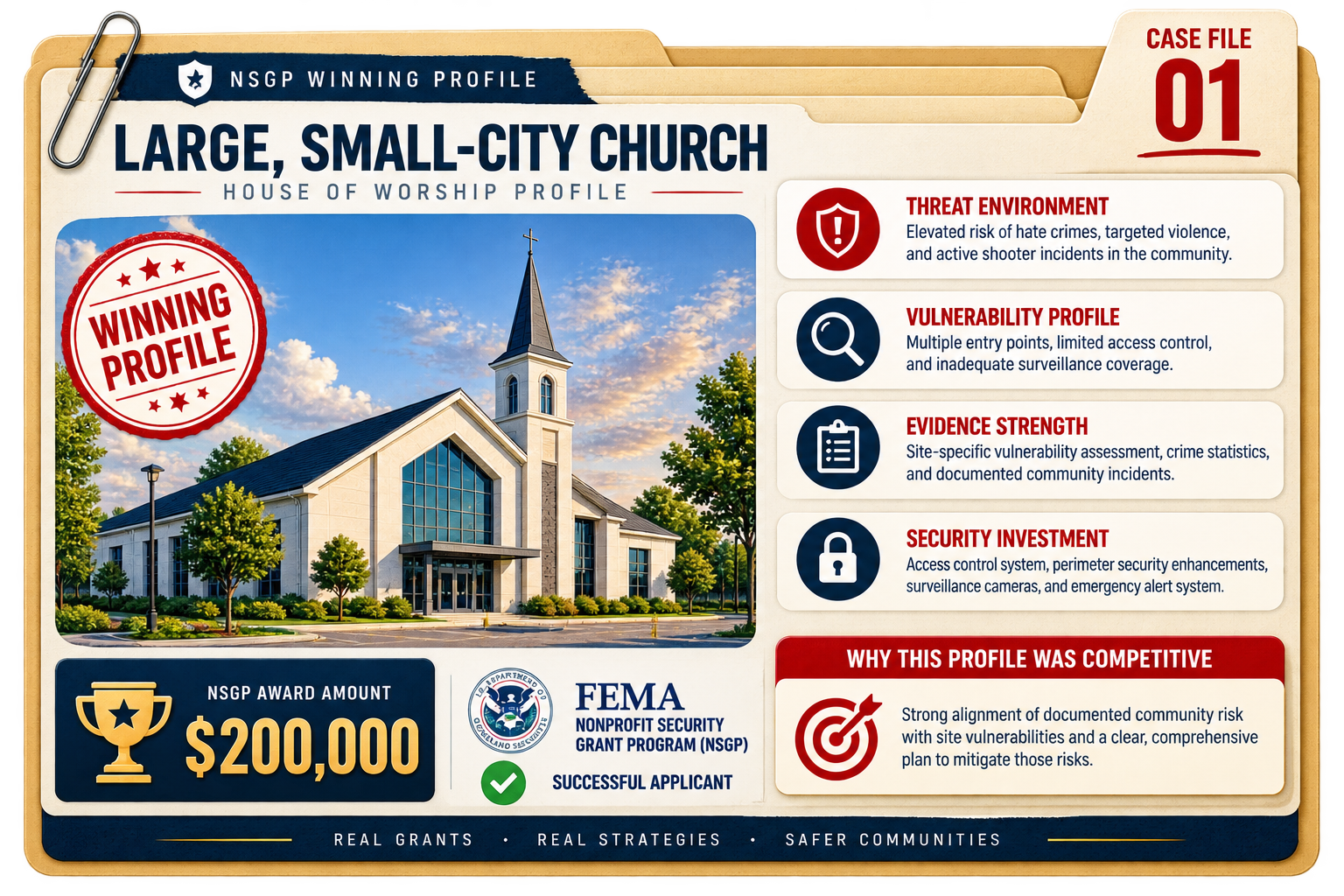
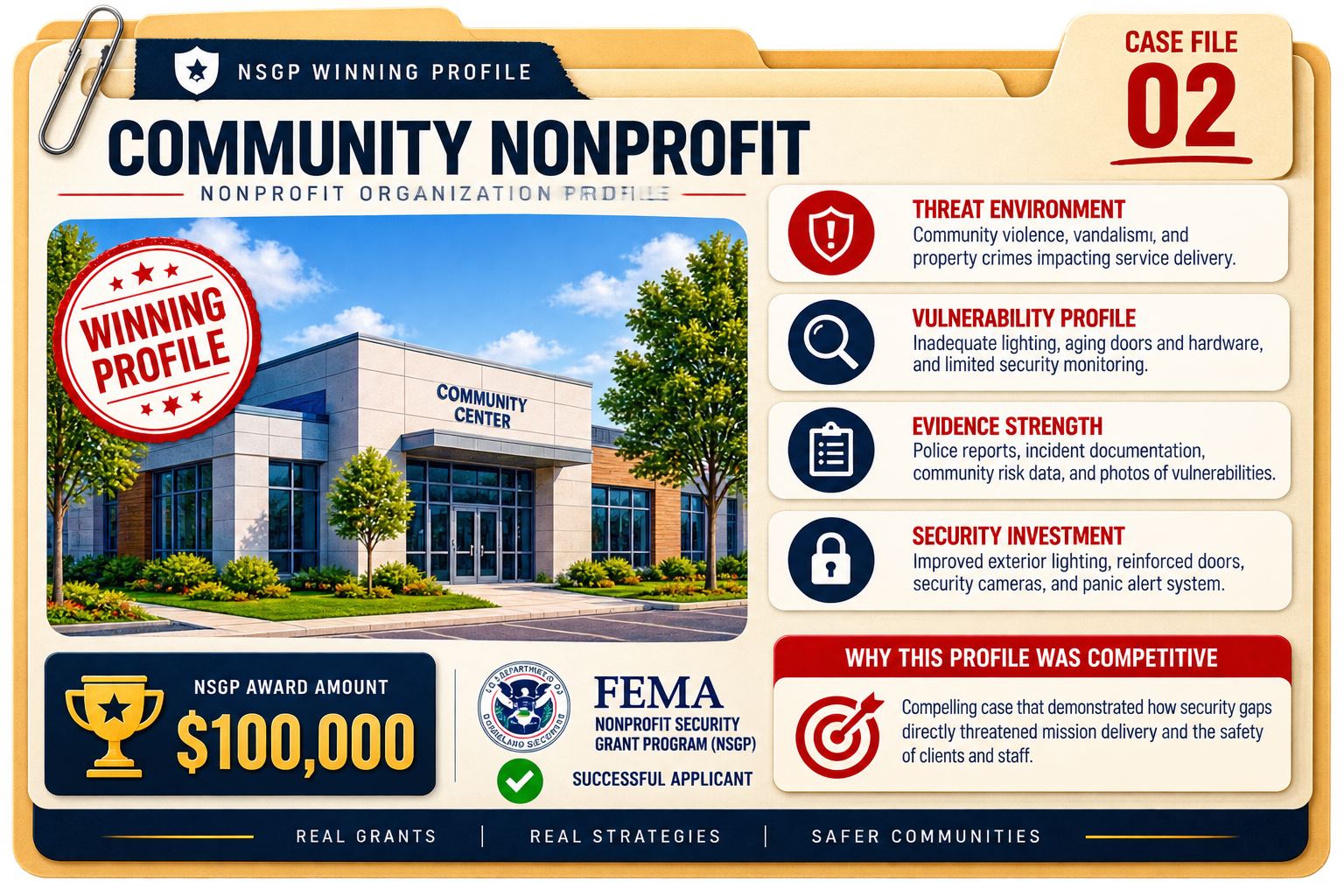
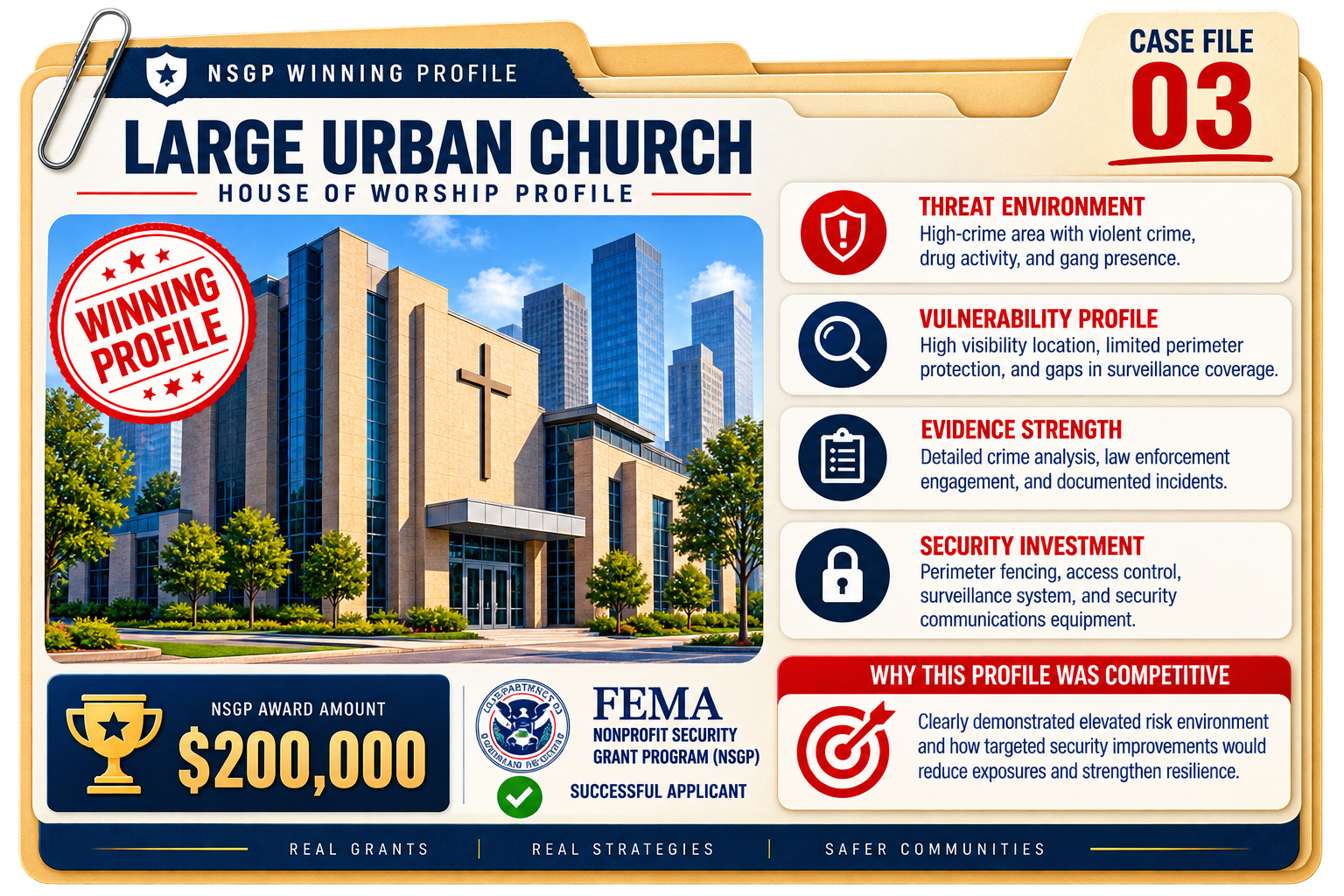
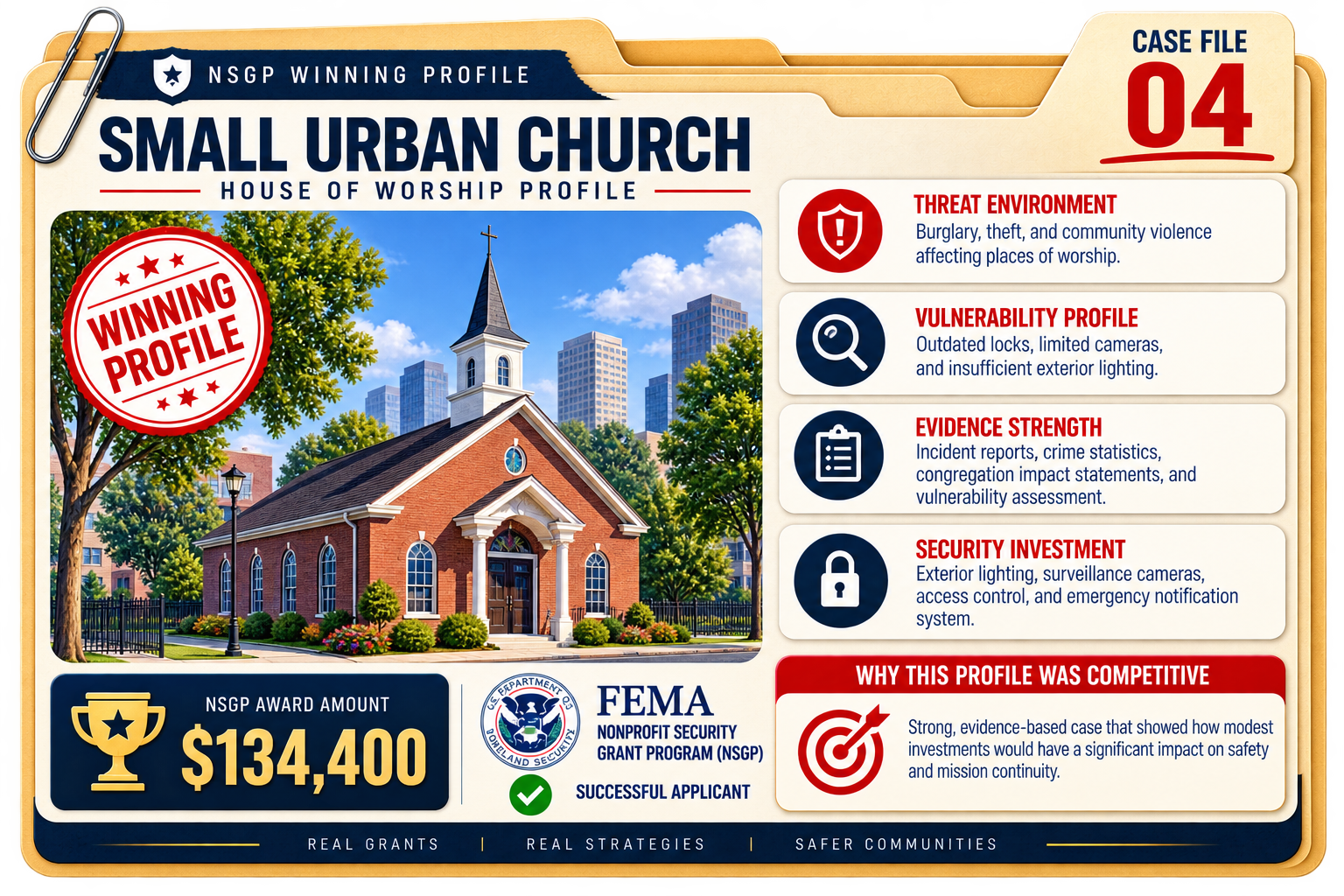
In Florida's FY2025 cycle, four of six PM3 client applications were awarded.
Those awards included multiple organizations and two separate sites operated by the same nonprofit.
These are real client profiles from previous cycles.
A competitive case has to make sense.
For the specific organization and physical site.
Most security grant tools stop at whether an organization may be able to apply. That is only the first question. This short check combines basic nonprofit and site fit with your interest in professional support. A later PM3 conversation, when appropriate, examines financial execution capacity, documentation, and the strength of the security case.
A direct incident is not required to establish a threat environment. And not knowing something is not the same as the answer being no.
CHECK MY ELIGIBILITY & SERVICE FIT
I have scored federal applications from the other side of the table as a federal grant reviewer. I know what a reviewer sees, what they score, and what makes them set a file aside because I have been the person reviewing the file.
This streamlined process introduces the program, checks basic site fit, and directs interested consulting prospects to a brief organizational intake and booking, or self-guided visitors to federal resources.
Answer five questions about your nonprofit status, site, security concerns, improvements, and willingness to document vulnerabilities.
Answer three quick questions about your timing, involvement in decisions, and interest in paid professional assistance or free resources.
Potential professional-services prospects move to a short NSGP organizational intake. Self-guided visitors and those with foundational gaps receive FEMA resources.
Submit your contact and facility profile, then choose an appointment time. During the 45-minute session, PM3 confirms relevant details and discusses potential next steps.
The goal is to reserve professional-service conversations for organizations that have a potentially relevant security need and want to consider consulting support. All results are preliminary; the 45-minute conversation is where PM3 confirms the fit.
This is federal funding passed through each state's emergency management or homeland security agency. The federal notice sets the national framework, but the application deadline, forms, and competition are managed at the state level.
This is an extensive FAQ because the program has real rules, state-level differences, and practical questions that are worth understanding before you apply. Open the questions that matter to you, then complete the short fit check when you are ready.
No. A direct incident can strengthen a case, but it is not the only way to establish risk. A credible case can also be supported by the documented threat environment, location, comparable incidents, organizational exposure, community conditions, and other evidence. The organization still has to demonstrate risk under the rules for the current cycle.
Plan as though you will. A site-specific vulnerability assessment is a central part of NSGP because the proposed project should address identified security gaps. Current Georgia and Michigan guidance requires one with the application, and other states may set their own format or timing requirements. Always check the current instructions for your state.
No. NSGP can support eligible at-risk nonprofit organizations beyond houses of worship, including certain educational, community, medical, cultural, and other nonprofit organizations. Eligibility and risk still have to be established for the organization and physical site.
Potentially, yes. NSGP applications are site specific, and organizations operating multiple physical locations may be able to submit for more than one site when the cycle permits it. Each location needs its own defensible case, and the number of sites allowed can change by cycle and state.
The ceiling can change from year to year. Recent NSGP cycles have allowed requests of up to $200,000 per physical site in multiple states, including current FY2026 guidance in Texas and Michigan. Always confirm the maximum for the specific cycle and state before building the budget.
NSGP has generally not required a traditional nonprofit match in recent cycles. For example, Texas FY2026 guidance lists no match requirement. The current FEMA notice and your state's guidance control, so verify the requirement for the cycle in which you apply.
In some states, yes. Florida has used an advance-request process for NSGP recipients, and Michigan has published advance procedures in prior NSGP guidance. Advances are not automatic, and the documentation, minimum request, timing, banking, and liquidation requirements can be very specific. The rules can also change by state and cycle.
Often, yes. NSGP is commonly administered on a reimbursement basis, which is why cash-flow and execution capacity matter. Some states may allow an approved advance or another payment process under defined conditions, so the award agreement and current state procedures should be reviewed before committing to purchases.
Certain contracted security personnel costs may be allowable when the current program guidance permits them and all restrictions are followed. For example, Texas FY2026 guidance includes contracted security personnel subject to the federal and state requirements. This is different from assuming the grant can cover any type of security staffing, so the exact cost should be checked before it is included.
Do not assume that you can. Pre-award costs may be ineligible for reimbursement, and some funded projects cannot begin until additional federal reviews or holds are cleared. Texas FY2026 guidance, for example, prohibits reimbursement of pre-award security expenses and places Environmental Planning and Historic Preservation holds on funded projects until the required review is complete. Wait for the applicable authorization before spending grant funds.
No. Nonprofit organizations generally apply through the State Administrative Agency that administers NSGP in their state. That is why deadlines, forms, submission systems, and some administrative procedures differ from state to state even though the funding is federal.
That may be the best time to start preparing. Strong cases are built before the application window opens. You can use that time to identify gaps, strengthen documentation, complete or update a vulnerability assessment, develop the project scope, obtain estimates, and prepare leadership so you are not trying to create the entire case under a short state deadline.
That is okay. You do not need to start with a shopping list. The stronger approach is to understand the threat environment and actual vulnerabilities first, then select the cameras, access controls, doors, lighting, fencing, communications, or other improvements that directly address those findings. The project should come from the risk, not the other way around.
No. NSGP is grant funding, not a loan, so properly used and documented grant funds are not repaid like borrowed money. However, award terms still have to be followed, and costs that are unallowable, unsupported, or noncompliant can be subject to repayment or other corrective action.
Nothing. This eight-question on-page check is free and offers immediate guidance about whether to explore professional assistance or official government resources. The check does not submit responses to PM3. Interested consulting prospects complete a separate organizational intake before booking. None of these steps is an official eligibility decision or includes grant writing or a full security assessment.
Important: FEMA requirements, award ceilings, allowable costs, payment procedures, and state administrative rules can change by cycle. The current FEMA Notice of Funding Opportunity and the guidance issued by your State Administrative Agency control.
Answer eight short questions right on this page. If there is potential fit and you want professional assistance, complete a brief organizational intake before scheduling your NSGP Assessment & Funding Fit Session. If you only want free information, we will guide you to official FEMA resources.
CHECK ELIGIBILITY & SERVICE FITAbout 2 minutes · One site at a time · No obligation